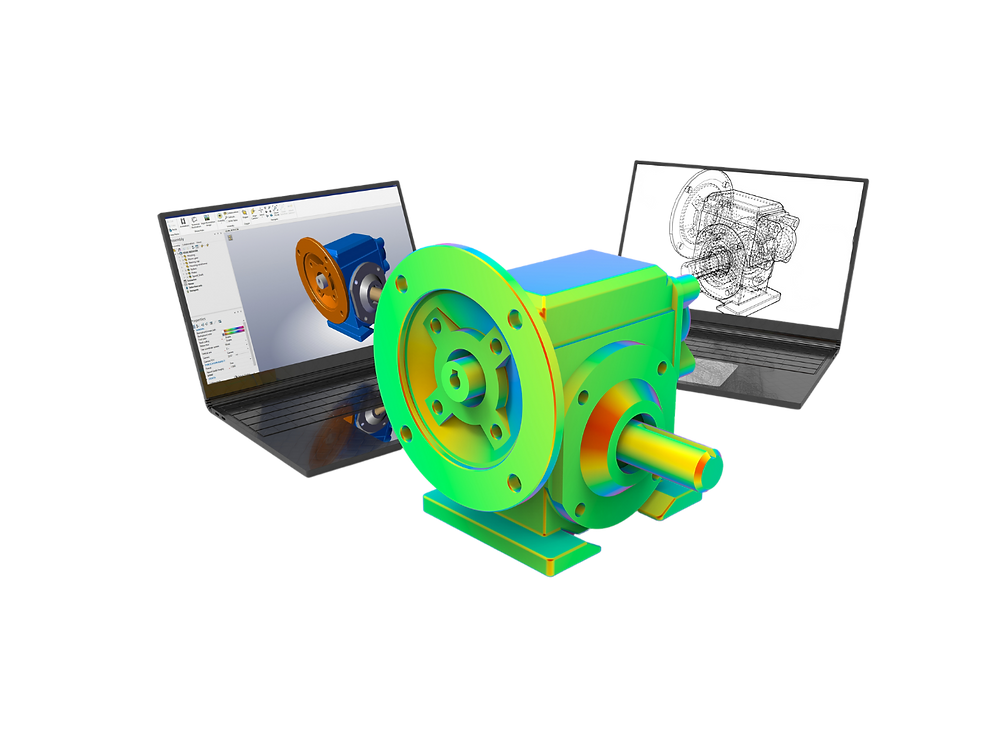
What is Abaqus?
Abaqus is a general-purpose FEA software suite — developed by Hibbitt, Karlsson & Sorensen (HKS) in 1978, now owned by Dassault Systèmes Simulia — particularly renowned for its advanced nonlinear analysis capabilities: complex material models, contact algorithms, and large deformation analysis.
Abaqus is the industry standard in automotive (crash and component analysis), aerospace (fatigue and damage tolerance, composites), and biomedical (implant mechanics, soft tissue simulation). It is available for Windows and Linux — not macOS. The Abaqus suite is an integrated suite including Abaqus/CAE (pre/post-processing GUI), Abaqus/Standard (implicit solver), Abaqus/Explicit (explicit solver), and Abaqus/CFD (CFD solver). Rated 4.3/5 from professional reviews.
Abaqus Standard vs. Abaqus Explicit — when to use each
The choice between Abaqus/Standard and Abaqus/Explicit depends on the time scale and nature of the physical event being simulated — not on preference.
| Characteristic | Abaqus/Standard | Abaqus/Explicit |
|---|---|---|
| Time integration | Implicit (Newton-Raphson iteration) | Explicit (central difference) |
| Stable time increment | Large — determined by convergence | Small — limited by CFL stability condition |
| Typical analysis types | Static, quasi-static, frequency, heat transfer, fatigue | Impact, crash, drop test, explosion, metal forming, high-speed machining |
| Convergence | Requires convergence at each increment — can diverge | Unconditionally stable per step — no convergence issues |
| Memory use | Assembles global stiffness matrix — memory-intensive for large models | No global matrix assembly — scales better for very large models |
| Contact | Handles complex contact but can have convergence difficulties | General contact by default — extremely robust for complex contact |
Pros and cons of Abaqus
| Pros | Cons |
|---|---|
| Best-in-class for nonlinear material analysis — hyperelastic, elastoplastic, creep, viscoelastic, composite CDM | GUI less intuitive than Ansys — steeper learning curve for new users |
| Robust contact algorithms — both implicit and explicit | Expensive — pricing not public; indicative $20,000+ perpetual |
| Extremely comprehensive documentation — verification and validation manual, example problems | Not compatible with macOS |
| Python scripting interface — full model automation and parametric studies | Meshing less automated than Ansys Workbench — requires more manual effort |
| Integrated solver — no external solver needed for Standard or Explicit | Multi-physics coupling (CFD+structural) less seamless than Ansys Workbench |
| Industry standard in aerospace, automotive, and biomedical — validated workflows |
Abaqus pricing
Abaqus pricing is not publicly listed. Contact Dassault Systèmes Simulia for a quote. Indicative prices for perpetual licenses start above $20,000 for the base package — with additional modules (Abaqus/CFD, CATIA integration) increasing cost.
A free Student Edition is available from recognised universities for non-commercial, educational use. A 30-day trial may be available through the Simulia Academic Program. Annual maintenance is typically 18–20% of the perpetual license cost.
Key features of Abaqus
Advanced material models
Abaqus's material library is the most comprehensive in any FEA package — elastic, hyperelastic (Mooney-Rivlin, Neo-Hookean, Ogden, Marlow), elastoplastic (isotropic, kinematic, combined hardening), viscoelastic, creep, concrete damage plasticity, geomechanics, composite progressive damage (Hashin CDM), and user-defined (UMAT/VUMAT) for completely custom material models.
Contact capabilities
Abaqus has the most robust contact algorithms for complex nonlinear structural problems. General Contact in Abaqus/Explicit handles thousands of contact pairs automatically. Surface-to-Surface and Node-to-Surface contact in Standard handles large sliding, friction (Coulomb, rough, frictionless), and tied contact. Cohesive elements and surfaces for delamination and debonding.
Python scripting interface
The Abaqus Scripting Interface (ASI) provides full access to the Abaqus model database via Python — enabling parametric model creation, automated design studies, batch job submission, and custom result post-processing. The macro recorder generates Python from GUI actions, making learning the API straightforward.
Frequency and dynamics
Modal analysis (frequency extraction), steady-state dynamics (harmonic response), random vibration (PSD), transient dynamics (implicit and explicit), coupled acoustic-structural, and pre-stressed natural frequencies. Full spectral analysis support for earthquake engineering and vibration qualification.
Fatigue and fracture
Abaqus supports fracture mechanics (J-integral, stress intensity factors), crack propagation (XFEM, cohesive zone, virtual crack closure), and fatigue life prediction (Rainflow counting, S-N and ε-N based). The fe-safe integration (Simulia product) extends Abaqus for advanced fatigue analysis.
Alternatives to Abaqus
| Alternative | Best for | Key difference |
|---|---|---|
| Ansys Mechanical | Multi-physics, broader accessibility, Workbench integration | More intuitive GUI; broader multi-physics; less powerful nonlinear material |
| HyperWorks + OptiStruct | Meshing quality, structural optimisation, Nastran-compatible | Better meshing; unit-based licensing; strong in topology optimisation |
| COMSOL Multiphysics | Multi-physics R&D, lower entry cost | Better multi-physics coupling; lower cost; less powerful for pure structural |
| LS-DYNA | Explicit dynamics — crash, impact, blast, forming | Strongest explicit dynamics solver; strongest in crashworthiness specifically |
Frequently asked questions
What is Abaqus used for?
General-purpose FEA — particularly nonlinear structural analysis, dynamic simulations, impact and crash analysis, thermal analysis, and composites. Widely used in aerospace, automotive, biomedical, and civil engineering.
What is the difference between Abaqus Standard and Abaqus Explicit?
Standard uses implicit time integration — for static and quasi-static analysis. Explicit uses explicit time integration — for fast transient events like impact, crash, drop testing, and metal forming where inertia effects are significant.
How much does Abaqus cost?
Not publicly listed. Contact Dassault Systèmes Simulia for a quote. Indicative prices start above $20,000 perpetual for the base package. Free Student Edition available for academic users.
Can Abaqus be scripted with Python?
Yes — the Abaqus Scripting Interface provides full Python access to the model database. All GUI actions are recorded in abaqus.rpy, making the API learnable through the macro recorder.