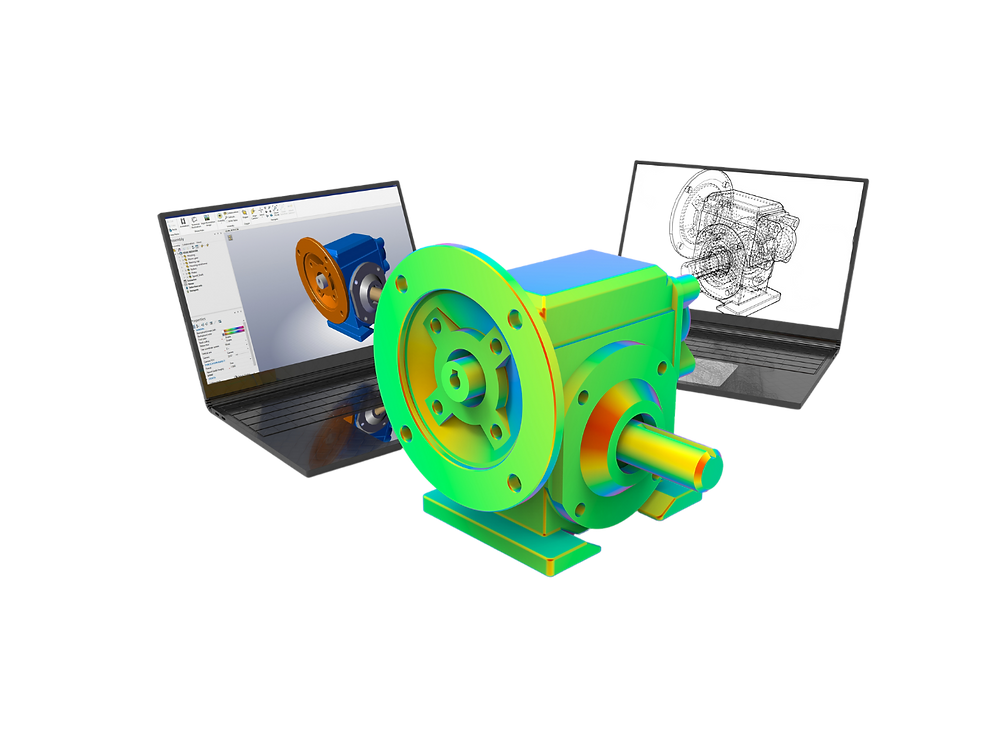
What is Ansys Mechanical?
Ansys Mechanical is a finite element solver that simplifies the structural verification of multiple design scenarios by enabling engineers to customise its GUI and automate FEA models through Ansys Workbench.
Part of the broader Ansys Suite, Ansys Mechanical has use cases across aerospace, automotive, green energy, and biomedical engineering. Engineers use it to simulate structural mechanics, acoustics, and thermal analysis — including transient and nonlinear analyses. The platform helps engineers analyse how designs behave under different physical conditions and identify areas for improvement.
Ansys Inc. was founded in 1970 in Canonsburg, Pennsylvania. Today it serves thousands of organisations globally, including BMW, Siemens, and NASA (which awarded Ansys a 5-year modelling and simulation contract).
Developer: Ansys Inc. | Founded: 1970 | HQ: Canonsburg, Pennsylvania | Deployment: On-premise + cloud | Rating: 4.2/5 (71 reviews)
Pros and cons of Ansys Mechanical
| Pros | Cons |
|---|---|
| All modules in one suite — move from mechanical to thermal to CFD without switching software | Expensive — pricing not fixed; varies by modules and seat count |
| Advanced, customisable GUI — workflows and simulations can be automated and parameterised | Steep learning curve for new users unfamiliar with multi-physics simulation |
| Advanced results visualisation tools | High hardware requirements (RAM, GPU) for efficient solving |
| Free training courses offered by Ansys Inc. via Learning Hub | Meshing control is less advanced than dedicated tools like HyperMesh |
| Flexible CAD import — geometry can be modified mid-simulation | License costs can spiral with additional physics modules |
Ansys Mechanical pricing
Based on quotations received, Ansys Mechanical starts at approximately $22,000 for a perpetual license — for the base Ansys Mechanical module only.
Pricing increases significantly with additional modules. Ansys Fluent (CFD) and Ansys HFSS (electromagnetics) each carry additional costs. Pricing is negotiated with Ansys sales teams and varies by seat count, modules, and region. Demos and free trials can be requested from Ansys. Annual maintenance and support adds approximately 18–20% of the license cost per year.
Key features of Ansys Mechanical
CAD geometry import
Engineers can seamlessly import and work with CAD models directly in Ansys Mechanical, preparing geometry for analysis without leaving the environment. The flexible interface allows design changes at any point during the simulation process.
Advanced materials modelling
Ansys includes advanced material models — viscoelastic, plasticity, damage — to accurately represent a wide variety of materials including metals, composites, polymers, and concrete.
Coupled field technology
Multi-physics simulations including thermal-structural coupling, fluid-structure interaction, and electromagnetic-structural analysis — all within the same Workbench environment.
Automated meshing adaptivity (NLAD)
Automatically adapts the mesh in areas of high deformation or stress, providing more accurate results with reduced manual effort in nonlinear analyses.
Explicit dynamics
Tools for high-speed, highly nonlinear events — drop tests, impact simulation, and blast analysis — complementing the standard implicit solver.
Fatigue life analysis
S-N curve analysis, cumulative damage analysis, and Rainflow counting — covering the full fatigue simulation workflow within a single environment.
Target market
Ansys is best suited for larger organisations with multiple engineering departments that need cross-discipline collaboration and validated multi-physics simulation. The "ideal buyer" has the budget for the perpetual license and the team size to justify the investment across structural, CFD, and electromagnetic disciplines simultaneously.
Alternatives to Ansys Mechanical
| Alternative | Best for | Key difference |
|---|---|---|
| Abaqus | Highly nonlinear FEA, complex materials | Stronger for contact and nonlinear material models; similar price |
| Altair HyperWorks + OptiStruct | Lightweight design, optimisation, meshing | Superior meshing (HyperMesh); unit-based licensing model |
| Nastran (MSC/Siemens) | Aerospace structural validation | Industry standard for aero structural; less multi-physics breadth |
| COMSOL Multiphysics | Multi-physics R&D, custom PDEs | More accessible multi-physics for research; lower cost |
Frequently asked questions
How much does Ansys Mechanical cost?
Based on quotations received, Ansys Mechanical starts at approximately $22,000 for a perpetual base license. Additional modules increase cost. Annual maintenance adds ~18–20%. Contact Ansys sales for a specific quote.
What is Ansys Mechanical used for?
Structural mechanics, thermal analysis, acoustics, and multi-physics simulation. Used across aerospace, automotive, green energy, and biomedical engineering to analyse designs under structural loads, heat, and dynamic conditions.
Is Ansys better than Abaqus?
Ansys excels in multi-physics breadth (structural + CFD + electromagnetics in one suite). Abaqus is generally stronger for highly nonlinear material analysis and contact problems. Best choice depends on your analysis types and toolchain.
Is Ansys available for free?
Ansys Student is free for educational use with model size limits. Free training is available via the Ansys Learning Hub. Commercial use requires a paid license from ~$22,000.