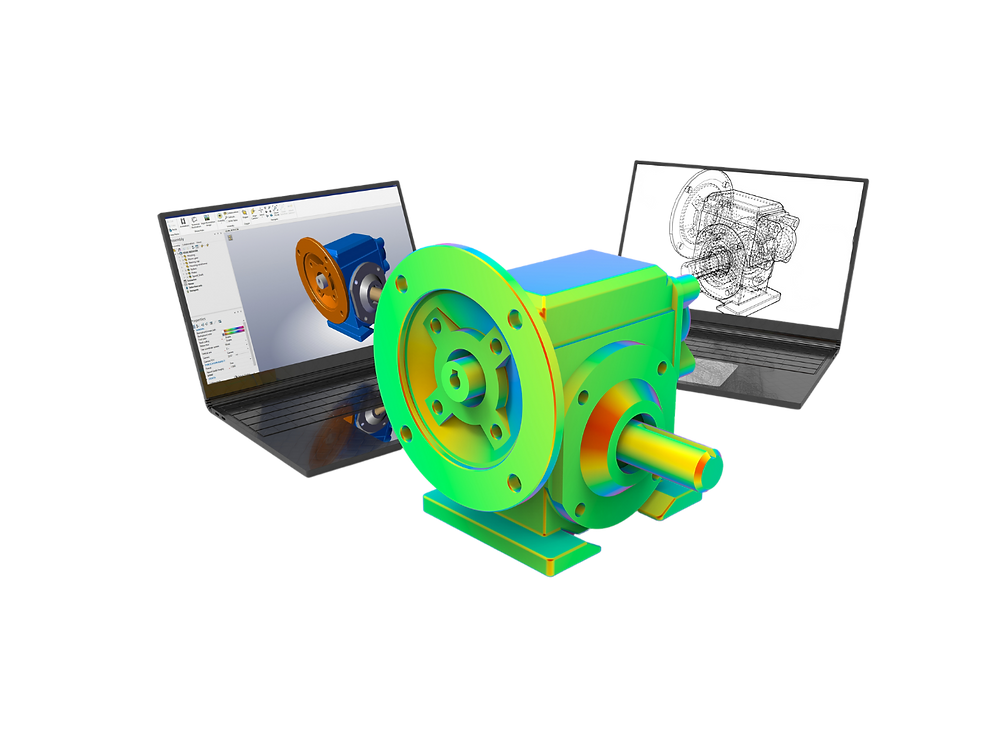
What is COMSOL Multiphysics?
COMSOL Multiphysics is a cross-platform FEA software environment for modelling engineering, physics, chemistry, and biology problems — particularly powerful for coupled multi-physics where multiple physical domains interact simultaneously.
Originally developed in Sweden in 1986 as FEMLAB, COMSOL is now headquartered in Burlington, Massachusetts. It is available for Windows, Linux, and macOS — one of very few FEA tools with native macOS support. It is rated 4.2/5 from 31 professional reviews.
Pros and cons of COMSOL Multiphysics
| Pros | Cons |
|---|---|
| Best-in-class for coupled multi-physics in a single model | Module costs accumulate — can become expensive for full-capability access |
| Runs on Windows, Linux, and macOS — rare for FEA software | Steeper learning curve for complex multi-physics setups |
| LiveLink for MATLAB, SolidWorks, Inventor, CATIA integration | Less powerful than dedicated tools (Abaqus, Fluent) for single-physics intensive problems |
| Lower entry cost than Ansys ($3,495/yr vs. $22,000+ perpetual) | Slower convergence for highly nonlinear structural problems |
| Custom PDE capability — flexible for novel or non-standard physics | Not suitable for explicit dynamics (crash, impact) |
| Strong built-in documentation and application library (hundreds of verified examples) | Smaller user community than Ansys or Abaqus |
COMSOL Multiphysics pricing
COMSOL Multiphysics commercial licenses start at approximately $3,495/year for a single user including the core package. Academic licenses start at approximately $1,495/year.
Additional physics modules each add to the base license cost. The full suite with all physics modules is significantly more expensive. However, for teams needing a subset of physics — for example, structural + thermal — COMSOL's modular pricing is competitive. A free 30-day trial is available. Contact COMSOL for a tailored quote based on your physics selection and seat count.
Key features of COMSOL Multiphysics
Coupled multi-physics simulation
COMSOL's defining strength: couple any combination of physics in a single model — structural deformation driven by thermal expansion from resistive heating in an electromagnetic coil, for example. Multiphysics couplings are bidirectional and solved simultaneously, not loosely coupled between separate solvers.
LiveLink for CAD and MATLAB
LiveLink add-ons enable synchronised, parametric CAD integration — changes in SolidWorks, Inventor, AutoCAD, CATIA, or NX propagate automatically into the COMSOL model. LiveLink for MATLAB enables parametric studies, optimisation, and custom result post-processing from MATLAB scripts.
Physics module library
Available modules include: Structural Mechanics, Nonlinear Structural Materials, CFD, Heat Transfer, Electromagnetics (AC/DC, RF, Wave Optics), MEMS, Chemical Reaction Engineering, Acoustics, Batteries & Fuel Cells, and more. Each module adds validated physics interfaces for the relevant domain.
Application Builder
COMSOL's Application Builder allows engineers to create custom simulation apps — giving non-FEA-experts access to simulation through a simplified GUI, without exposing the full COMSOL interface. Apps can be deployed via COMSOL Server within an organisation.
Parametric sweep and optimisation
Built-in parametric sweeps allow automated studies across design variables. The Optimisation module enables gradient-based and derivative-free optimisation of objective functions defined from simulation outputs.
Target market
COMSOL targets R&D engineers, researchers, academics, and national labs working on novel or multidisciplinary problems — sensors, microfluidics, fuel cells, piezoelectric actuators, thermoelectric generators, plasma physics, and biomedical devices. It is less appropriate for large-scale structural analysis or crashworthiness programs where Abaqus or LS-DYNA are the standard.
Alternatives to COMSOL Multiphysics
| Alternative | Best for | Key difference |
|---|---|---|
| Ansys (Workbench) | Enterprise multi-physics, large-scale structural | More powerful individual solvers; looser coupling; higher cost |
| Abaqus + Abaqus/CFD | Nonlinear structural with FSI | Stronger nonlinear; more complex multi-physics setup |
| OpenFOAM + OpenCASCADE | CFD + custom coupling, HPC research | Open-source; no cost; steep learning curve; no GUI for structural |
| SimScale | Cloud-based CFD/FEA for SMEs | Browser-based; no hardware needed; less capable for multi-physics |
Frequently asked questions
How much does COMSOL Multiphysics cost?
Commercial licenses start at ~$3,495/year (single user, core package). Academic from ~$1,495/year. Additional physics modules add to the cost. Contact COMSOL for a tailored quote.
What is COMSOL Multiphysics used for?
Coupled multi-physics FEA — combining structural mechanics, fluid flow, heat transfer, and electromagnetics in a single model. Widely used in R&D, universities, and national labs.
What is the difference between COMSOL and Ansys?
COMSOL is stronger for tightly coupled multi-physics and custom PDE problems. Ansys has more powerful individual solvers for dedicated analysis types. COMSOL's entry price is significantly lower.
Does COMSOL integrate with MATLAB?
Yes — LiveLink for MATLAB enables bidirectional integration for parametric studies, optimisation, and custom post-processing from MATLAB.